Compare Singapore and Hong Kong holding companies for Canadian businesses, including tax, treaty benefits, banking, exempt surplus, and Asia expansion.
Singapore and Hong Kong are Asia's two great holding-company hubs, and Canadian owners routinely end up choosing between them. The good news: both are treaty countries with Canada. The decision usually comes down to where your business points.
The tax headline
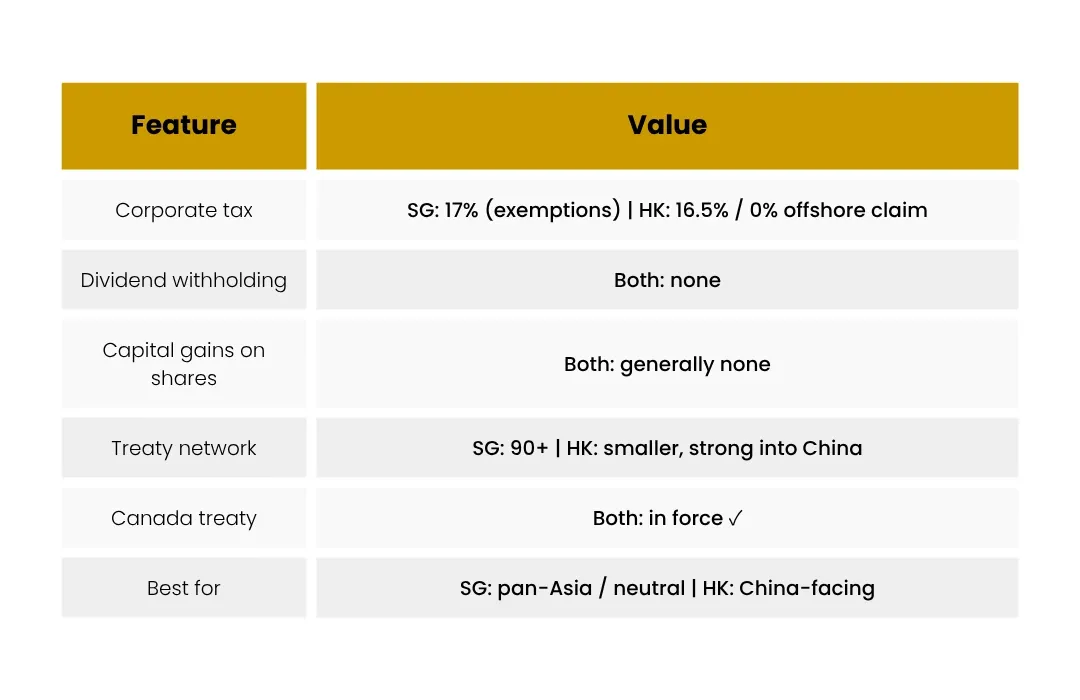
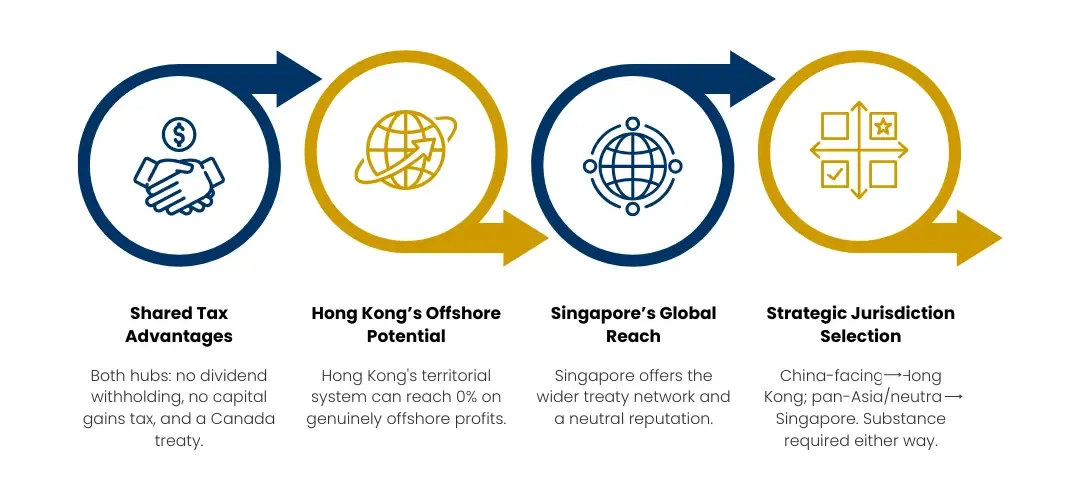
Singapore taxes corporate profits at 17%, softened by partial and start-up exemptions. Hong Kong is territorial: profits sourced outside Hong Kong can, with a valid offshore claim, be taxed at 0%, while Hong Kong-sourced profits are taxed at 16.5% (8.25% on the first HK$2m under the two-tier rates). Both impose no withholding tax on dividends and no capital gains tax.
Treaties and reach
Singapore has the wider treaty network - well over 90 agreements - which matters if your subsidiaries pay dividends, interest or royalties up the chain and you want those withholding taxes reduced. Hong Kong's network is smaller but growing, and unrivalled as a conduit into mainland China, where the China–Hong Kong arrangement delivers low withholding rates.
Reputation, banking and the China question
Both are world-class for banking and rule of law. In practice we see a simple split:
- China-facing groups - manufacturing, sourcing, or selling into the mainland - usually favour Hong Kong.
- Pan-Asian or globally neutral groups, family offices, and the venture-backed often prefer Singapore for its perceived neutrality and stability.
Substance rules now apply in both: Hong Kong's foreign-sourced income exemption (FSIE) regime was reformed in 2023–24 and, like Singapore's Section 10L, expects real economic activity behind the structure.
The Canadian angle
Here's the part that simplifies the decision: both Singapore and Hong Kong are treaty countries with Canada, so active business income from either reaches exempt surplus and can be repatriated tax-free to a Canadian corporate parent. From a pure Canadian-repatriation standpoint they're on equal footing - so choose on commercial fit, banking and where your subsidiaries sit, not on the surplus rules.
Frequently asked questions
Is Hong Kong really 0% tax?
Only on profits genuinely sourced outside Hong Kong, supported by a valid offshore claim and - since the FSIE reform - adequate substance for certain passive income. Hong Kong-sourced profits are taxed at up to 16.5%. It's not automatic.
Which is better for raising venture capital?
Singapore is often preferred by global VCs for its neutrality and familiar company law, though both are credible. The right answer depends on your investor base.
Can I redomicile from one to the other later?
Both jurisdictions allow forms of re-domiciliation or you can restructure, but it's costly and has tax consequences in Canada and locally. Better to choose well at the outset.
Do Canadian reporting obligations differ between them?
No - a foreign affiliate in either jurisdiction triggers the same Canadian Form T1134 reporting and surplus tracking. The Canadian compliance is identical.