
A Singapore holding company can help Canadian founders access treaty benefits, exempt surplus treatment, and a strong base for Asia-Pacific expansion.
Singapore is the jurisdiction Canadian founders ask about first - and for good reason. But a Singapore holding company is a tool, not a trophy. Here is when it genuinely earns its place in your group, and when a plain Canadian holdco does the job for less.
What Singapore actually offers
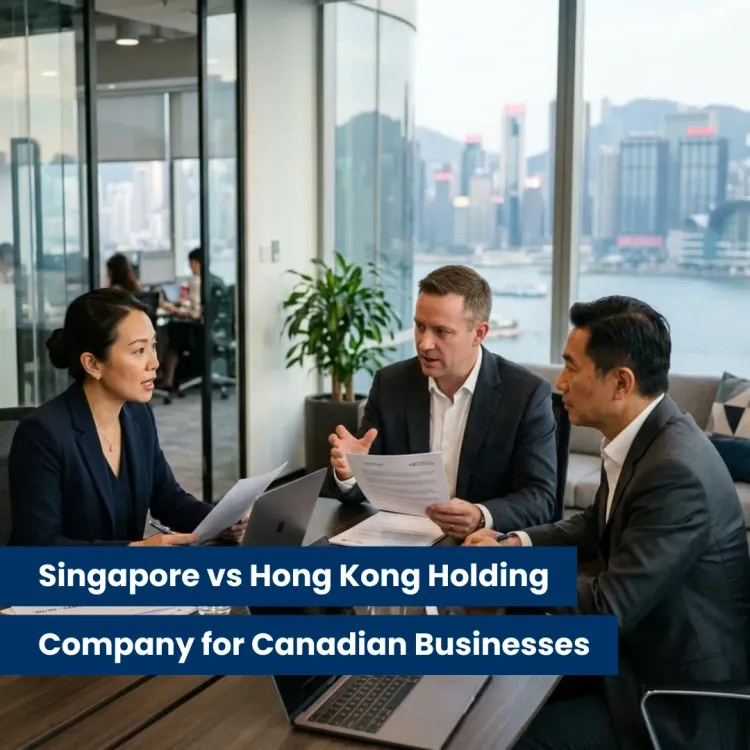
Singapore has spent two decades building exactly what a holding company wants: a stable common-law system, a respected regulator (ACRA), deep multi-currency banking, and one of the world's widest tax-treaty networks. For a Canadian group expanding into Asia, that combination is hard to replicate.
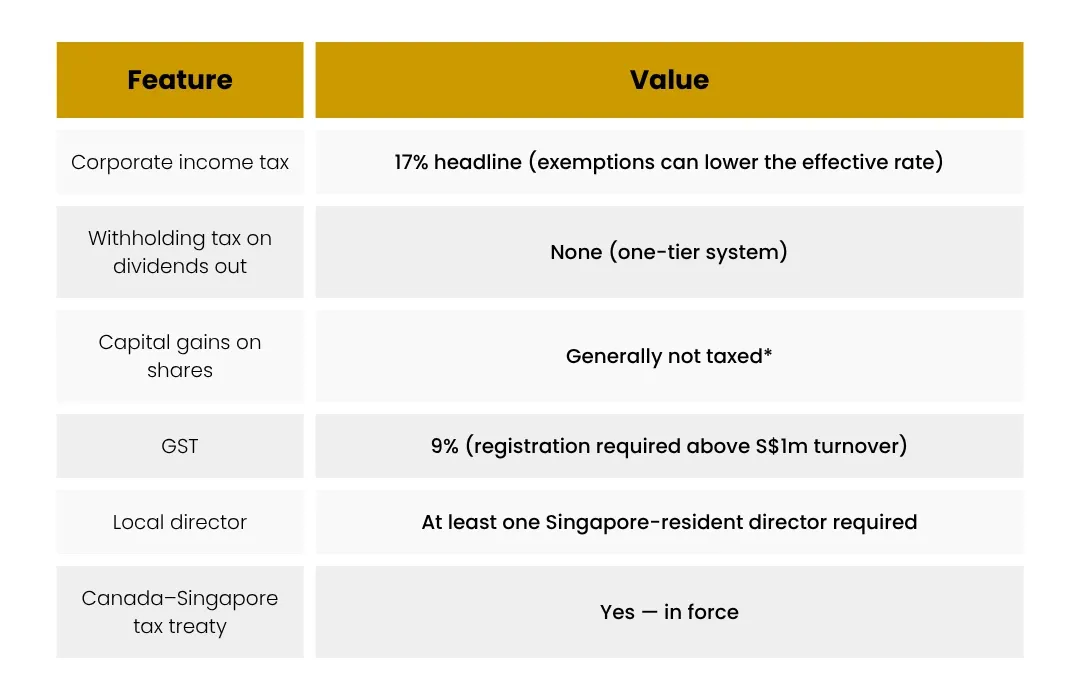
The headline tax picture is attractive. Corporate income tax is 17% (with partial exemptions and start-up reliefs that lower the effective rate on early profits), there is no withholding tax on dividends under Singapore's one-tier system, and capital gains on shares are generally not taxed - so profits can flow up and exits can happen without a Singapore tax leak.
When a Singapore holdco actually makes sense
The case is strongest when several of these are true:
- You hold or plan to hold operating subsidiaries across Asia-Pacific - Singapore's treaties cut the withholding tax those subsidiaries deduct when paying dividends, interest or royalties upward.
You want a credible, bankable regional headquarters that customers, investors and banks recognise instantly.
You are raising capital or planning an eventual sale and want a clean, neutral holding layer above the operating businesses.
You can put real activity in Singapore - people, decisions, or management - not just a brass plate.
When it doesn't
If your subsidiaries are all in Europe or North America, an Irish, Dutch or Cypriot holdco usually gives better treaty routing into those regions. And if you have no foreign subsidiaries at all, a Singapore company just adds cost and a second set of filings with no treaty benefit to capture. Structure should follow where your business actually operates - never the other way around.
One recent change to know about
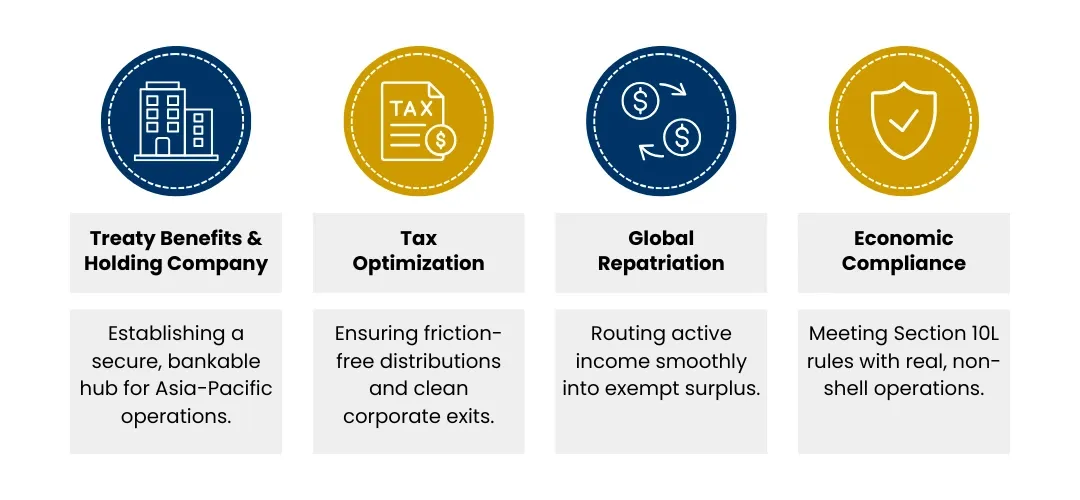
From 1 January 2024, Singapore's Section 10L can tax certain foreign-sourced gains on the disposal of foreign assets if the selling entity lacks adequate economic substance in Singapore. The message is consistent across every modern jurisdiction: substance is no longer optional. A holdco that exists only on paper is a liability, not a shelter.
The Canadian angle
Because Canada has a tax treaty with Singapore, the active business income of your Singapore foreign affiliate generally lands in its "exempt surplus" pool - meaning it can be paid up to a Canadian corporate parent as a tax-free dividend. That treaty status is the single biggest reason a treaty hub like Singapore can beat a zero-tax island for an active group. Passive income is a different story - see our FAPI articles.
Frequently asked questions
Do I need to move to Singapore to own a holding company there?
No. You can own and direct a Singapore company from Canada. You must appoint at least one Singapore-resident director (often a nominee service), and you'll want genuine decision-making substance, but personal relocation isn't required.
Will I be taxed in Canada on the Singapore company's profits?
It depends on the income type. Active business income generally sits in exempt surplus and can be repatriated tax-free to a Canadian corporate parent. Passive income (interest, portfolio dividends, rents) is typically caught by Canada's FAPI rules and taxed currently in Canada.
Is a Singapore holdco better than a Canadian holdco?
Only if you have foreign subsidiaries whose withholding tax the treaty can reduce, or a genuine need for an Asian HQ. With no foreign operations, a Canadian holdco is usually simpler and cheaper.
How long does incorporation take?
Often 1-3 business days once KYC, name approval and the resident-director arrangement are in place. Bank account opening typically takes longer and varies by provider.