
Guide to the Corporate Tax Rate in Canada for 2026
If you operate a business in Canada, corporate taxation is a critical pillar of your financial health. Every year, companies must pay taxes on their profits, and staying ahead of these rates is the best way to protect your cash flow.
Understanding the projected corporate tax rates in Canada for 2026 allows for more accurate tax planning and reduces the risk of “surprise” tax bills. While tax law can seem daunting, this guide breaks down the essential figures into a practical roadmap for your business.
Why Corporate Tax Rates Matter in 2026
Your corporate tax rate determines how much profit your business actually keeps to reinvest in growth or pay out to shareholders. Knowing the 2026 rates now allows you to make informed decisions regarding business expenses, savings, and investments in an evolving economic landscape. Even a small percentage shift in the tax rate can significantly impact your bottom line. At Orbit Accountants, we believe it is essential for business owners—not just their accountants—to understand these fundamentals to maintain true financial clarity.
Key Terminology and Concepts
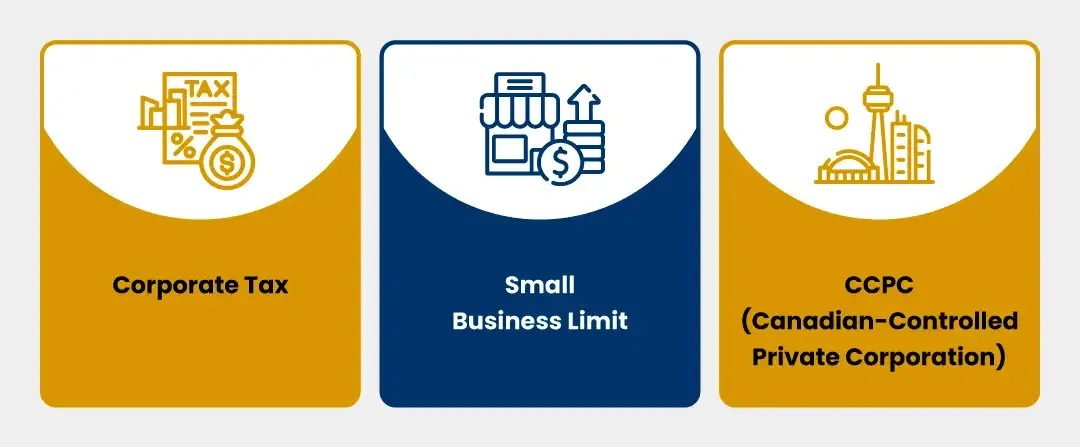
Corporate Tax: Taxation placed on earnings after business expenses are deducted. This is levied at both Federal and Provincial levels.
Small Business Limit: This is the “low-tax threshold.” It is the maximum amount of income (usually $500,000) that qualifies for lower tax rates before higher general rates apply.
CCPC (Canadian-Controlled Private Corporation): Private companies controlled by Canadian residents. These entities often qualify for the most significant tax incentives
Are you confident your business tax filings are fully optimized and compliant?
General Deadline: Six Months After Year-End
Typically, Canadian corporations are expected to file their T2 return within six months of the end of their fiscal year. This is not always the calendar year; it is based on your company’s selected fiscal year-end date.
For example, if your corporation has a fiscal year-end of December 31, 2025, your filing deadline would be June 30, 2026. If your fiscal year ends March 31, 2026, your T2 tax return must be filed by September 30, 2026. To determine your timeline, count six months forward from your fiscal year-end.
Provincial Variations: Corporate Tax Across Canada in 2026
Corporate tax rates vary by province, meaning your total tax bill depends heavily on where you operate. Provinces use these rates as incentives to attract specific industries or businesses. For example, Alberta and British Columbia maintain different rate structures than Ontario or Quebec.
Corporate Tax Rate Ontario 2026: What to Expect
Ontario remains a primary hub for many of our clients. For 2026, based on current legislation, we expect the following:
General Corporate Rate: Projected to remain constant at approximately 11.5%.
Small Business Rate: Qualifying businesses may pay as little as 3.3% on income within the small business limit.
Orbit Advisor Tip: Always verify your qualifications for the Small Business Rate annually. Missing this eligibility can lead to an unnecessarily high tax bill.
What If Your Tax Year Doesn’t End on December 31?
Canadian businesses can select a fiscal year-end most appropriate for their operations. To calculate your specific dates, count six months forward from your year-end for your filing date and two or three months forward for your payment date.
Combined Corporate Tax Rate: Federal + Provincial in 2026
The combined corporate tax rate is the sum of your federal corporate tax rate and provincial corporate tax rate. So, if your federal tax rate is 15%, and your provincial tax rate is 11.5% (Ontario), then the combined rate total would be 26.5%. However, for small businesses, because of the Small Business Deduction, the combined corporate tax rate could be much less than this. Hence, the combined rate you pay will reflect the actual percentage of profits that you will pay in taxes.
Detailed 2026 Canada Corporate Tax Rate Table
In this table, you can find general corporate tax rates in 2026 (of selected provinces) that include both federal and provincial taxes on a combined basis.
| Province | General Combined Rate (Approx.) |
| Ontario | 26.5% |
| Alberta | 23% |
| British Columbia | 27% |
| Quebec | 26.5% |
These rates are subject to change and can change with the ever-changing trends of government tax policies. Always consult your tax authority to confirm latest rates prior to submitting your return.
Canada Business Tax Rate: Filing a T2 Return in 2026
Every corporation in Canada must file a T2 Corporation Income Tax Return annually—even if the business was inactive or didn’t earn a profit.
Deadline: Your T2 must be filed within six months of your fiscal year-end.
Penalty Prevention: Filing on time is mandatory to avoid CRA penalties and interest charges, regardless of whether tax is owed.
Maximizing Deductions and Credits
Strategic bookkeeping is the foundation of tax savings. By maintaining accurate records, you can claim essential deductions such as:
Salaries and benefits.
Office rent and utilities.
Marketing and advertising.
Research & Development (SR&ED) credits.
Final Thoughts
Staying proactive with your 2026 tax strategy ensures your business stays fueled for the future. By utilizing the Small Business Deduction and filing on time, you minimize liability and maximize peace of mind.
At Orbit Accountants, we specialize in taking the complexity out of the Canadian tax system. From expert bookkeeping to Fractional CFO advisory, we help growing businesses concentrate on their vision while we handle the numbers.
FAQs
What is the federal corporate tax rate in 2026?
The federal general rate is projected to be 15%. When provincial taxes are added, the total typically ranges between 23% and 27%.
What is the small business tax rate in 2026?
Eligible CCPCs generally pay a federal rate of 9% on the first $500,000 of income, plus a lower provincial rate, leading to a much lower combined total than the general rate.
Do I have to file if my business made no money?
Yes. All registered Canadian corporations are required to file a T2 return annually, regardless of income level.
Disclaimer: This article is for informational purposes only and does not constitute professional tax, legal, or accounting advice. Tax rates and regulations are subject to change by federal and provincial governments. Always consult with a qualified professional—like the team at Orbit—before making financial decisions.