What is a Tax Identification Number (TIN) in Canada?
As a way for the government to track taxes, both individuals and businesses are given unique numbers called Tax Identification Numbers (TINs). TINs are similar to ID cards, but are only for tax purposes. If you have a TIN, it connects you or your business to your tax records and facilitates the accurate and organized recording of your tax information.
In Canada, the Canada Revenue Agency (CRA) uses your TIN to identify taxpayers, track payments, and manage the tax system. Taxation would be much more complicated and less secure without a TIN.
In this blog, we will go over what a tax identification number is, why it’s important, the various tax identification number types, how to apply for one, and where to find your tax identification number when you need it.
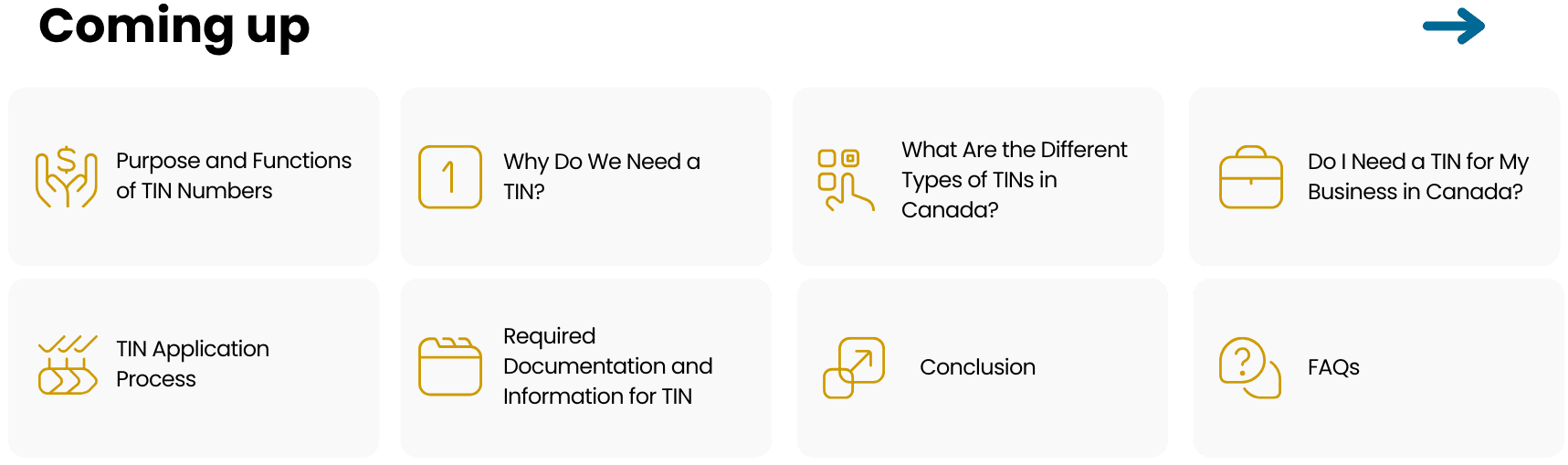
Purpose and Functions of TIN Numbers
A Tax Identification Number (TIN) allows tax authorities to identify a taxpayer and link tax payments to the correct individual or business. In Canada, a TIN is used for filing income tax returns, paying taxes, and establishing a history of tax compliance. For taxpayers, it ensures taxes paid are properly recorded. For the government, it supports fair and efficient tax administration.

Why Do We Need a TIN?
Before getting into the details, it’s important to understand why a TIN is required.
Tracking Tax Obligations
One reason you want a TIN is to track any tax obligations you may owe. Every citizen or business is required to pay their tax obligations for that tax year. If you were to pick some of the poorer examples, a TIN would be an example that some would use to profile records with the CRA. The TIN is an advantage to the taxpayer since it serves the purpose of assuring no one is actually paying more than they owe or less.
Identifying Taxpayers
Another reason is that it identifies taxpayers. If there were no unique numbers, two people with the same name could easily be confused. A TIN ensures your tax history is connected to you only, and not someone else.
Assisting HMRC
Despite HMRC being the UK’s tax authority, the same concept applies in Canada with the CRA. Tax identification systems facilitate authorities exchanging information accurately, if required, across the globe – for example, if you have tax obligations in Canada and England, it would be much easier to reconcile your records in both Countries with a TIN.
Assisting Tax Authorities
While HMRC is the UK tax authority, the same concept applies in Canada with the CRA. Tax identification systems help authorities exchange accurate information globally when required.
What Are the Different Types of TINs in Canada?
There is no universal tax identification number (TIN) in Canada. Rather, if you are a person or a corporation, the CRA will issue a different kind of identification number that can be used as your TIN. The most common TINs used by the CRA are as follows:
Social Insurance Number (SIN)
A Social Insurance Number (SIN) is a 9-digit number that they use to report their income, keep track of their earnings, and apply for government benefits.
Business Number (BN)
A BN is a 9-digit number required for corporate tax, payroll deductions, GST/HST accounts, and import/export activities.
Individual Tax Number (ITN)
For import/export purposes, payroll deductions, GST/HST accounts, and corporate tax filings, a 9-digit number is required, which is known as a business number (BN).
Temporary Tax Number (TTN)
Trusts and other non-individual entities that are required to report income can apply for a Temporary Tax Number (TTN).
Do I Need a TIN for My Business in Canada?
If you are running your business in Canada, you will need a Business Number (BN) from the CRA to be used. This applies whether you are a sole proprietor, a partnership, or a corporation. The Business Number is your tax number used for corporate income tax, GST/HST accounts, payroll deductions, and import/export activities. Even if you have a part-time business and are just operating online, you still must register for a BN in order to accurately file your taxes and not incur penalties or additional review issues with the CRA. The Business Number is required to participate in certain business activities, especially when collecting GST/HST or hiring employees.
TIN Application Process
In Canada, how you apply for a TIN will depend on your individual circumstances. Individuals do not apply for a TIN separately because, in most instances, their Social Insurance Number (SIN) is their TIN. Businesses will need to apply for a Business Number (BN) through the CRA, and the BN serves as the TIN number for businesses.
Here’s how you apply:
For Individuals (SIN):
- You can apply online, by mail or in person at a local Service Canada office.
- You will need to provide proof of identity and legal status in Canada.
- Once you have been assigned your SIN, you will use that same number for life.
For Businesses (BN):
- You can apply online through the CRA website, or you can phone in your application.
- For businesses, you will need to provide your legal name, what type of legal structure your business has, and how you are identifying yourself as a business owner.
- A Business Number stays valid for the life of a business and will cover the corporation for corporate tax purposes as well as GST/HST, payroll and import/export accounts.
Required Documentation and Information for TIN
Documentation requirements vary depending on whether you are applying as an individual or a business.
| Applicant Classification | Documents / Information Needed |
|---|---|
| Individuals | Identity documents (passport, birth certificate, residency card) Legal status in Canada Completed application form |
| Businesses | Legal business name and structure Address and contact details Owner identification CRA registration form |
Conclusion
A Tax Identification Number (TIN) may sound intimidating, but it’s just a unique number that ties you to your tax records. It serves to help tax authorities record an accurate tax history, track payments, and create a fair tax system. The most important thing to remember is that your TIN is yours and should be protected. You should only use your TIN in secure and legitimate locations. By understanding what your TIN is, you will be able to remain organized, reduce the amount of tax-related issues and ensure that you meet all of your tax obligations timely manner.
If you want to make sure that your tax identification numbers are properly registered, safe, and used appropriately, whether SIN, BN or ITN, Orbit Accountants is the right partner for you. We have been providing professional tax compliance services for individuals and businesses throughout Canada. Our team can assist you with the application for your TIN (s), the maintenance of accurate records and following CRA guidelines to remain in compliance. By working with us, you will be able to avoid costly mistakes & reduce time spent worrying about tax processes, so that you can focus on your business or finances with confidence.
Reach out to us today for a free consultation to learn more about our services in greater detail.
Frequently Asked Questions
Where can I locate my tax identification number?
In Canada, the TIN for most individuals is your social insurance number (SIN) and business is your business number (BN). You can find your SIN on your tax return, your notice of assessment, or the original SIN card or letter from Service Canada. You can typically find your Business Number on correspondence from the CRA or your registration documents.
Are EINs and TINs the same?
No. An Employer Identification Number (EIN) is a number specific to the United States that is used for businesses. They serve similar purposes to a TIN; however, they are different numbers and different countries issue them.
Is a TIN the same as a UTR number?
Not exactly. A UTR (Unique Taxpayer Reference) is specific to the United Kingdom tax system and used by self-employed individuals and businesses. A UTR can be considered a TIN in the UK, but is not the same as a Canadian TIN.
Disclaimer: This article is provided by Orbit Accountants for general information only and does not constitute tax, legal, or accounting advice. Rules may vary by province and change over time. For tailored guidance, consult Orbit Accountants directly.