
Learn how sole proprietor tax deductions work in Canada, what you can write off, how to report income on T2125, and what records you need to keep.
If you are self-employed, one of the most common questions you will ask is simple: what can I actually deduct?
And fair enough. Most sole proprietors in Canada are not trying to game the tax system. They just do not want to overpay because they missed legitimate write-offs. The problem is that most articles on this topic stay too generic. They tell you “keep receipts” and “claim your home office,” but they do not explain how sole proprietor taxes actually work in real life.
That is where things get messy. Maybe you work from home. Maybe you use your car for both personal and business trips. Maybe you pay for software, a phone plan, and supplies out of the same account. Or maybe your compensation is not even straightforward, like doing work in exchange for reduced rent.
This guide breaks down sole proprietor tax deductions in Canada in a practical way so you can understand what belongs on your return, what needs caution, and when it may be time to level up your structure
How Sole Proprietor Taxes Work in Canada
A sole proprietor does not file a separate corporate return. Instead, you generally report your business income and expenses on your personal return using Form T2125, Statement of Business or Professional Activities. CRA uses that form to calculate your gross income and net business income.
That means your business profit is taxed in your own name.
A few important points come with that:
- Self-employed individuals generally file their personal return by June 15, but any balance owing is still generally due by April 30 to avoid interest.
- If you are self-employed, you also pay the full CPP contribution yourself rather than splitting it with an employer. CRA states that self-employed people pay the full contribution based on net business income.
- If your taxable revenues exceed the $30,000 small supplier threshold, you may need to register for GST/HST and start charging it. In some cases, voluntary registration may also make sense.
So yes, deductions matter. Every reasonable business expense you properly claim can reduce your net income and, in turn, your tax bill.
Common Sole Proprietor Tax Deductions in Canada
The CRA’s basic rule is straightforward: you can generally deduct reasonable current expenses you incur to earn business income, but not personal expenses, and not the full cost of capital property right away.
Here are the write-offs most sole proprietors should understand.
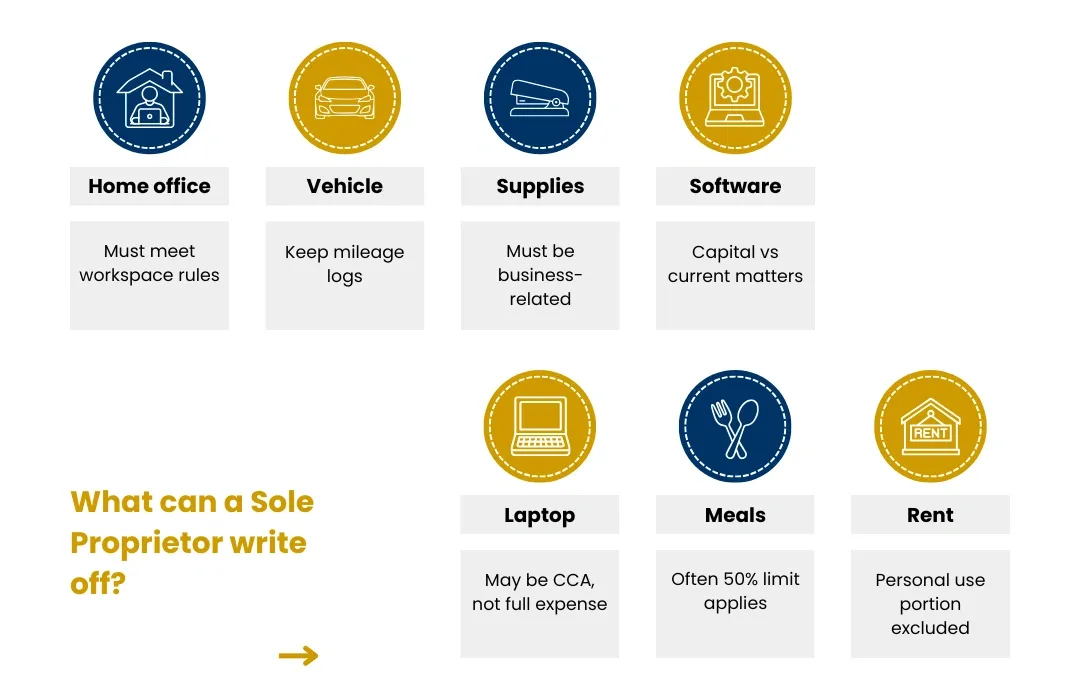
Home office expenses
If you work from home, you may be able to deduct part of your rent, utilities, insurance, maintenance, property taxes, and mortgage interest, depending on your situation. But the workspace must either be your principal place of business or be used only to earn business income on a regular and ongoing basis to meet clients, customers, or patients. The CRA also says business-use-of-home expenses cannot create or increase a business loss.
For renters, this is a big one. You may be able to deduct a reasonable portion of rent if part of your home is genuinely used for business. Not the whole apartment. Just the business-use portion.
Motor vehicle expenses
If you use your vehicle for business, you may be able to deduct the business-use share of fuel, insurance, maintenance, licence and registration fees, leasing costs, and eligible interest. But you need a mileage log. CRA expects records showing total kilometres driven and business kilometres, along with trip details.
This is where many sole proprietors either underclaim or overclaim. The correct answer is usually somewhere in the middle.
Supplies and office costs
Small everyday items used to run the business can usually be deducted. Think stationery, postage, and basic office supplies. CRA distinguishes these from capital items like desks, chairs, and filing cabinets, which are not expensed the same way.
Software and subscriptions
This is one people often get wrong. Monthly software subscriptions used to run the business are often current operating expenses. But a laptop, computer equipment, or certain software purchases may be capital assets and claimed over time through capital cost allowance rather than deducted all at once.
Bank charges, accounting fees, and admin costs
Bank fees, payment processing charges, bookkeeping fees, accounting fees, and other admin costs directly tied to the business are often deductible.
Meals and entertainment
Yes, these can be deductible in some business situations, but usually not at 100%. CRA’s general rule is that the maximum claim is 50% of the reasonable amount incurred.
The Rent-for-Work Situation: When Compensation Is Not Straightforward
This is where generic tax blogs usually fail.
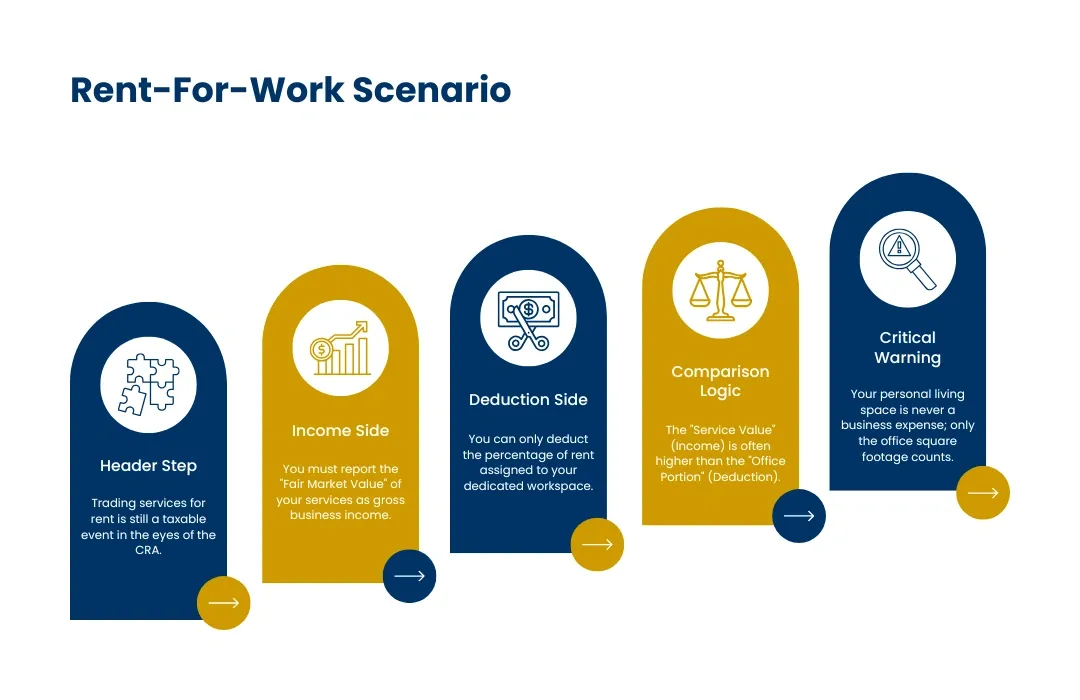
Let’s say you are a music teacher, coach, or freelancer and you provide services in exchange for a rent reduction. It may feel informal. But from a tax perspective, it usually is not.
CRA says that in a barter transaction, if you exchange goods or services in the course of business, the value of what you receive can be considered business income. In other words, if you performed services and received reduced rent or some other benefit in return, that value may still need to be reported.
Now for the part people miss: that does not automatically mean the full rent becomes a deduction.
If the space is your personal residence, you generally cannot turn a personal living cost into a full business write-off just because the “payment” took a non-cash form. At most, you may be looking at a business-use-of-home claim for the workspace portion, assuming the CRA rules are met.
So in a rent-for-work setup, you need to review:
- what service was provided
- the fair value of that service
- what benefit you received
- whether any part of the space qualifies as business use
- whether the arrangement was documented properly
This is one of those areas where a quick review with an accountant can save you from a very avoidable reporting mistake.
Record-Keeping Best Practices
Good tax returns start with good records. Not perfect records. Just clean ones.
CRA says you should keep your records and supporting documents for at least six years from the end of the relevant tax year. Receipts matter, but so do bank statements, agreements, invoices, and other support for what you claimed.
For sole proprietors, a simple system goes a long way:
- use a separate business bank account
- avoid mixing personal and business spending
- save receipts as you go, not at year-end
- track mileage throughout the year
- use a document capture tool like Hubdoc or a similar system
- review your books monthly, even if revenue is still small
A lot of tax pain comes from one problem: trying to rebuild an entire year in April.
When Does It Make Sense to Incorporate?
Not every sole proprietor should incorporate right away. If your business is still lean, your costs are simple, and most of the profit is needed personally, staying a sole proprietor may still be fine.
But incorporation starts to deserve a real look when:
- profits are becoming more stable
- liability exposure is rising
- you want clearer separation between personal and business finances
- you are thinking about bringing in a partner or investor
- your tax planning needs are getting more complex
If you are already earning solid income and still paying everything through one personal account, that is usually a sign the structure needs a closer look.
How Orbit Helps Sole Proprietors Maximize Returns
Most sole proprietors do not need complicated tax magic. They need clarity.
At Orbit, that usually means:
- cleaning up the books
- identifying missed deductions
- separating real business expenses from personal ones
- reviewing home office and vehicle claims properly
- flagging unusual situations like barter or rent-for-work arrangements
- helping you decide whether staying a sole proprietor still makes sense
That is where the value is. Not aggressive write-offs. Just the right ones, backed by clean records
Final Thoughts
Understanding sole proprietor tax deductions in Canada is less about chasing every possible expense and more about knowing the rules well enough to claim what is fair, reasonable, and supportable.
Some deductions are straightforward. Others are not. Home office claims, mixed-use vehicles, and rent-for-work arrangements can get technical quickly.
If you are unsure what to deduct, that is not a sign you are behind. It is a sign your business is real enough to need better structure.
FAQs
Do sole proprietors in Canada file a separate business tax return?
No. Sole proprietors generally report business income and expenses on their personal tax return using Form T2125.
Can I claim part of my rent if I work from home?
Often, yes. If your workspace qualifies under the CRA rules, you may be able to deduct a reasonable business-use portion of rent and certain home expenses.
Can I deduct my whole car payment?
Usually no. Vehicle claims are generally based on the business-use portion of eligible vehicle costs, and you should keep a mileage log to support the percentage claimed.
What happens if I am paid through barter or rent reduction?
You may still have reportable business income. CRA treats many barter transactions as taxable when goods or services are exchanged in the course of business.
How long should I keep receipts and records?
In general, at least six years from the end of the tax year they relate to.
Legal Disclaimer
This article is provided by Orbit Accountants for general informational purposes only and does not constitute legal, tax, or accounting advice. Your tax treatment depends on your specific facts, business activity, province, records, and filing position. Home office claims, vehicle expenses, barter arrangements, and incorporation decisions can involve technical tax rules. You should seek tailored advice before filing your return or claiming deductions that are not clearly documented. For advice specific to your situation, consult a qualified accountant or book a free consultation with Orbit Accountants to get started.